
Florida Gilded Mansions
If you’re anything like me—and a devoted fan of period-piece dramas—you’re probably busy polishing your tiaras and waiting with bated breath for the upcoming season of The Gilded Age.
Before the release of The Gilded Age Season 2, my best friend and I spent a long weekend living our best coastal New England lives in iconic Newport, Rhode Island. Naturally, we couldn’t resist immersing ourselves in the opulence of Newport’s legendary Gilded Age “cottages”—the grand summer homes of America’s wealthiest families.
We visited Marble House, the spectacular mansion commissioned by Alva Vanderbilt (later Alva Belmont); The Breakers, the lavish Vanderbilt estate built for Cornelius II and Alice Vanderbilt; and The Elms, the Berwind family’s grand Newport residence. The Elms is particularly fascinating: it remained staffed as a full-service Gilded Age estate well into the 1960s and serves as the setting for the Russell family’s Newport summer cottage in the show.
Read on to discover more about our Newport adventure in this blog post.
While New York was booming with business and Newport offered a coastal reprieve from the city, Florida was experiencing its own Gilded Age boom—fueled by the drive to explore new frontiers, the desire for escape, and the construction of lavish winter estates.
If you’re looking for your own historical drama moment and want to be transported to a time of elegance, wealth, excess, and extraordinary artistry, here are four magnificent gilded mansions to add to your Florida adventure list.
Let’s begin our grand tour with the home of Henry Flagler, the railroad baron and business tycoon who helped transform Florida. While his name may not immediately come to mind in the same way as Rockefeller, Flagler was a savvy businessman and visionary developer whose influence was instrumental in shaping Florida’s growth. His railroad connected towns along the state’s eastern coast, helping turn Palm Beach into a fashionable winter destination for America’s wealthy elite.

“Whitehall” was built as a wedding gift for Henry Flagler’s third wife, Mary Lily Kenan Flagler, and designed by architects John Merven Carrère and Thomas Hastings, who brought an extravagant Beaux-Arts vision to life, completing the grand estate in 1902.
Although Whitehall was built during the height of the Gilded Age for one of America’s most powerful tycoons, its design feels remarkably attuned to its tropical waterfront setting. The home’s many windows were positioned to invite the fresh ocean air through its grand halls, while a central courtyard, complete with a fountain and lush tropical plantings, brought the outdoors into the heart of the home. Outside, the Coconut Grove provided a picturesque setting for oyster roasts and entertaining.
With more than 75 rooms, Whitehall was certainly grand enough to host distinguished guests, including the Duke and Duchess of Manchester.
Today, the mansion continues to welcome visitors to its ornate interiors and hosts rotating exhibitions that explore art, history, and events of the time. During my visit, I had the chance to see an exhibition featuring Impressionist artist Charles Courtney Curran, as well as an exhibition exploring how the famed department store became an essential part of American shopping culture.
Wander through this magnificent Florida mansion and step into the world of the Gilded Age, where opulence, artistry, and the lives of the rich and famous come vividly to life.
Also located in Palm Beach is The Breakers, one of Florida’s most iconic grand hotels. And despite the name, this Breakers has no connection to Newport’s famous Breakers or the Vanderbilt family.
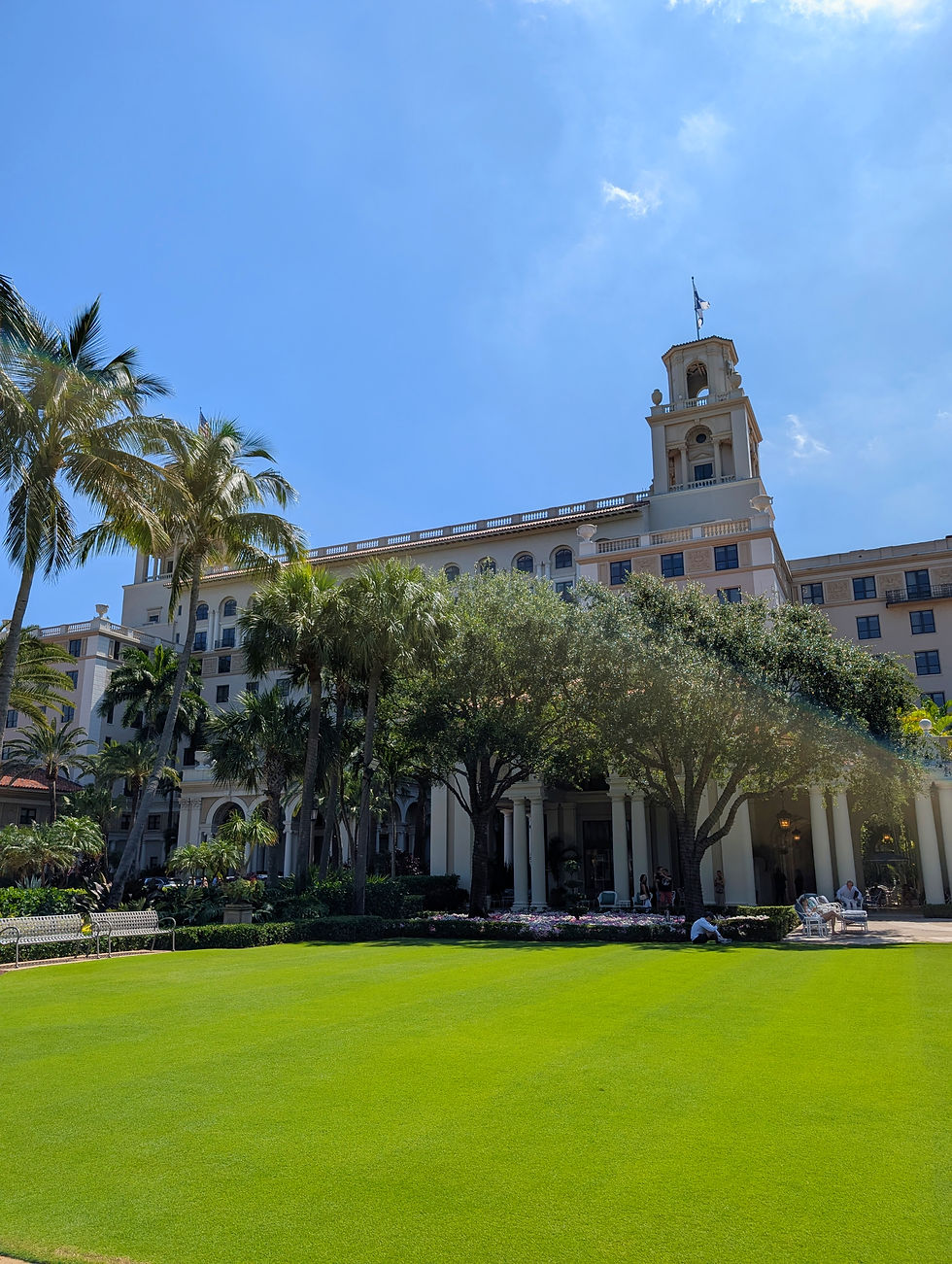
Originally known as the Palm Beach Inn, the hotel was built by Henry Flagler in 1895. After a devastating fire destroyed the property in 1903, Flagler quickly rebuilt it, renaming it The Breakers in reference to the sound of the waves crashing against the rocks just beyond the hotel walls.
While The Breakers was never a private residence and has always welcomed guests as a hotel, its architecture captures the grandeur and elegance of European palaces and palazzi. Architect Leonard Schultze drew inspiration from the Renaissance architecture of Genoa, Venice, and Florence, bringing an unmistakably European sense of grandeur to Florida’s sunny, palm-lined coast.
While some areas of the hotel are reserved for guests, visitors can still experience much of its spectacular beauty. Take advantage of the complimentary visitor parking and wander through the public spaces on the first floor. Enjoy a beverage in the courtyard, surrounded by hanging orchids, decorative tile floors, and bubbling fountains. Relax on a lounge overlooking the perfectly manicured lawn, admire the intricately detailed crown molding and colorful corridors, or stroll along the sidewalk once frequented by Palm Beach’s elite.
A visit to The Breakers is a chance to experience a little taste of the Gilded Age glamour that continues to define Palm Beach—no overnight stay required.
Our next Gilded Age stop takes us farther south—to Miami. Yes, Miami!
Just south of the heart of the city and north of Coconut Grove sits an Italian-inspired mansion so opulent and royal, you might find yourself wondering if you’ve somehow crossed the Atlantic. With its magnificent architecture, elaborate interiors, and sprawling gardens, this hidden gem feels worlds away from the glitz and glamour typically associated with Miami.
My friend and I visited this spectacular estate and its palace-like gardens during our own little Miami getaway, and it was the perfect setting for a decidedly different kind of Miami girls’ trip.
If you’re looking for a nontraditional Miami escape, be sure to check out my blog post for the full adventure.
Vizcaya was the dream of businessman James Deering and the creative vision of architect Paul Chalfin, bringing together the enchanting styles of the Italian Renaissance and Mediterranean Revival to Miami’s tropical coast.

Construction of this elaborate winter estate began in 1912 and continued even after Deering moved into the house, with the estate not reaching completion until 1922. As they say, beauty cannot be rushed!
Deering made his fortune in the agricultural machinery industry. He became head of the company after the Deering Harvester Company merged with the McCormick Reaper Company to form International Harvester. Although he amassed a fortune producing farm equipment, Deering was also a passionate plant conservationist. His love of plants and his desire for a warmer climate for health reasons drew him to South Florida, where he set out to create a winter retreat to immerse himself in such beauty.
The result was Vizcaya: an extravagant Italian-inspired villa surrounded by formal French gardens that rival Versailles, lush tropical landscapes, and breathtaking views of Biscayne Bay. The estate feels less like a Miami mansion and more like a European palace transported to the Florida coast.
So, if you’re craving an escape to Europe—or simply want to spend the day pretending you’re a millionaire-dollar princess arriving at her new Italian estate—be sure to dress the part! Just pair your glamorous outfit with comfortable walking shoes. You’ll need them exploring the Italian villa, wandering through the elaborate French gardens, and soaking in that warm ocean air.
And the final stop on our Florida Gilded Age grand tour takes us to Sarasota and the spectacular Ca’ d’Zan.
Ca’ d’Zan was the winter home of John and Mable Ringling—yes, those Ringlings of circus fame. Although the mansion was completed in 1926, well after the Gilded Age, it still embodies the era’s love of glamour, grandeur, and unapologetic excess.
Perched along Sarasota Bay, this magnificent Venetian Gothic mansion, with its ornate interiors and waterfront setting, is the perfect grand finale to our tour of Florida’s extravagant estates.

To discover everything there is to see and experience at The Ringling Museum, be sure to check out my blog post. And give yourself plenty of time to enjoy it all with two circus museums, an impressive private art collection, a spectacular winter mansion, and expansive gardens to explore. There’s plenty to see, and you'll want time to drink it all up like a bottle of champagne.
This impressive Venetian Gothic masterpiece was designed by architect Dwight James Baum, and its dramatic architecture sets it apart from the other mansions on our tour. The pointed windows, castle-like roofline, and intricate details give Ca’ d’Zan a distinctly medieval, Gothic character that feels worlds away from the grand Beaux-Arts estates we’ve visited.
The grandiose details continue inside, where elaborate ceiling paintings add to the sense of stepping back in time. My favorite room is the ballroom, with its striking octagonal tiles and charming vignettes of dancers dressed in traditional costumes from around the world, seemingly twirling across the floor. The wall of stained-glass windows in the Grand Salon washes the room in beautiful, colorful light.
And then there’s the pièce de résistance: the magnificent, colorful imported marble terrace overlooking the Gulf. It’s easy to imagine the likes of Alva Vanderbilt or Mamie Fish wishing they could have hosted one of their legendary soirées in a setting this spectacular.
But don’t stop at the mansion. Mable Ringling’s rose garden and the secret garden provide lush, romantic spaces to wander and admire. After all, what grand mansion would be complete without beautiful gardens to frame it?
I hope you’ve enjoyed our Gilded Age grand tour through Florida and discovered a few new places to add to your travel bucket list.
Florida has always been a place for dreamers—the exceedingly wealthy and your exceedingly average Joe alike—drawn to the promise of sunshine, opportunity, and a taste of life in a tropical paradise. So grab your gowns, tiaras, and sandals—your opulent tropical Gilded Age cottage awaits.


Comments